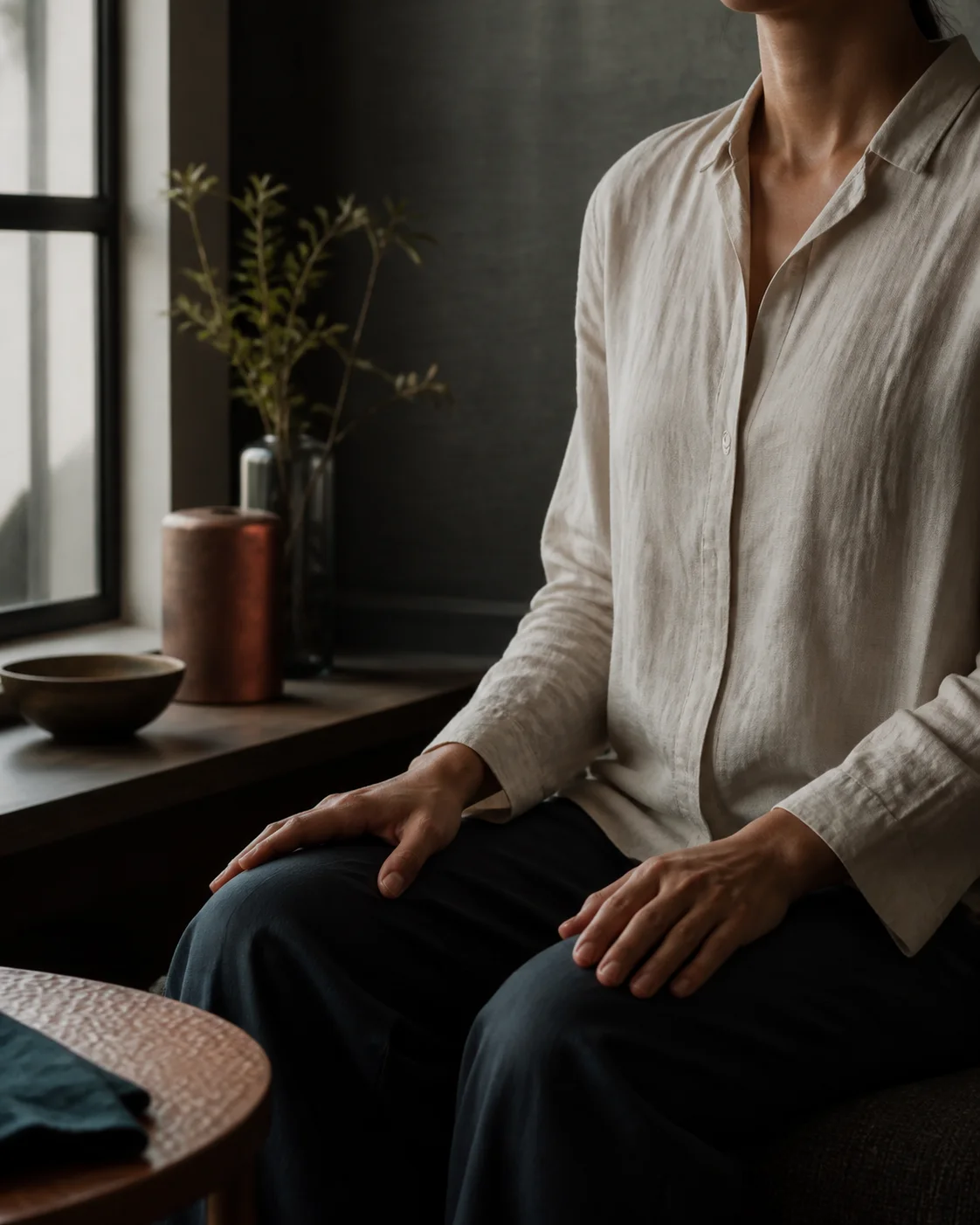
A five-minute starting point
- Sit or stand somewhere supported.
- Let your shoulders drop and notice both feet or the chair beneath you.
- Breathe gently into the abdomen if comfortable—without forcing a deep breath.
- Count up to five on the inhale and up to five on the exhale, shortening the count if needed.
- Continue for five minutes, then notice whether your state changed. Do not grade the session.
This closely follows the NHS breathing exercise for stress. The useful part is the combination of comfort, gentle pacing and repetition—not winning a breath-hold competition.
What “regulation” actually means
Your autonomic nervous system helps adjust bodily state to demand. Mobilisation is not bad; you need it to train, present, compete, respond and act. The problem is losing flexibility—struggling to come down after the demand has passed, or feeling unable to mobilise when action is required.
A regulation exercise is not a magic switch that proves your whole nervous system is “healed”. It is a small practice that may help change state, increase awareness or create enough space for a better next decision. Long-term regulation also depends on sleep, workload, relationships, health, environment and whether the source of stress actually changes.
The exercise is not the recovery system. It is one way to create enough room to build one.
Exercise 1: Slow, comfortable breathing
Slow breathing is the simplest place to begin because it is portable, free and adjustable. Aim for gentle rather than maximal. If a five-count inhale feels strained, use three. If breathing through the mouth or nose is uncomfortable, adapt it. The NHS guidance explicitly says to breathe as deeply into the abdomen as is comfortable, without forcing it.
The evidence is useful but more nuanced than social media suggests. In a 12-week randomised trial of 100 healthy adults, both slow-breathing groups reported reduced psychological stress. Extending the exhale did not outperform an equal inhale-to-exhale ratio, and the study did not find the expected change in HRV. That means slow breathing may be useful without pretending one ratio is universally superior or that every benefit must show up on a wearable.
Try it
Breathe gently for five minutes at a pace that feels sustainable. Keep the inhale and exhale even, or let the exhale become slightly longer if that feels natural. Stop if you become light-headed, breathless or more distressed.
Exercise 2: Widen your attention
Stress narrows attention. You stare at the screen, the problem, the argument or the internal sensation. Widening attention is a grounding practice: look around the room slowly, name five neutral things you can see, and notice where your body is supported.
This is not a claim that looking at a lamp “resets the vagus nerve”. It is a practical way to move attention away from a single threat cue and back into the present environment.
Try it
Keep your head and eyes comfortable. Name five colours, three sounds and two contact points—feet on the floor, back on the chair, hands on your legs. Spend sixty to ninety seconds doing only that.
Exercise 3: Release unnecessary muscular effort
Many people are using more muscular effort than the moment requires: jaw clenched, shoulders lifted, hands tight, abdomen held. The goal is not to become completely limp. It is to notice effort that is not helping.
Try it
On each exhale, choose one area and reduce the tension by ten per cent: jaw, tongue, shoulders, hands, abdomen. Small reductions are often easier to tolerate than demanding instant relaxation.
Exercise 4: Use easy rhythmic movement
Stillness is not calming for everyone. For an activated person—or an ADHD brain that experiences forced stillness as another demand—easy rhythmic movement can be a better entry point.
Try it
Walk for five to ten minutes at a pace where breathing remains easy. Leave performance metrics off. Let the arms swing, look ahead rather than down at a screen, and finish before it becomes training. The purpose is a state transition, not a fitness gain.
Exercise 5: Build a repeatable off-switch
A nervous system cannot learn that work has ended if work never produces an ending signal. A short shutdown ritual connects a repeated sequence with the transition out of demand.
Try it
- Write down what is unfinished and the first action for tomorrow.
- Close the work devices rather than leaving them visually open.
- Take five slow breaths or walk once around the block.
- Change location, lighting or clothing to mark the transition.
The ritual is deliberately ordinary. It works as architecture: fewer open loops, a consistent boundary and less dependence on deciding afresh every evening.
What about HRV?
Heart rate variability can provide useful context when measured consistently, but it is not a grade for whether you regulated correctly. Breathing itself changes beat-to-beat variation, which makes an HRV reading during slow breathing different from a stable morning trend.
A randomised trial in healthy adults found that practising deep slow breathing improved HRV measures without changing the authors' measure of overall cardiac autonomic balance. Another breathing trial found reduced self-reported psychological stress without the expected HRV change. Together, those results are a good reason to avoid reducing regulation to one number.
When an exercise is not enough
If the source of activation is unsafe work, financial pressure, trauma, illness, severe sleep disruption or a mental-health condition, another breathing exercise is not the whole answer. The environment and the appropriate support matter.
Speak to a GP or appropriate mental-health professional if stress is significantly affecting daily life, if symptoms are severe or worsening, or if you are struggling to cope. The NHS stress guidance includes routes to support and NHS talking therapies.
Where coaching fits
Nervous system coaching can help you practise state-change tools, read patterns across work, sleep and training, and build routines that reduce unnecessary load. It is non-clinical coaching. It does not diagnose or treat anxiety, trauma, autonomic disorders or any other medical or mental-health condition.